




























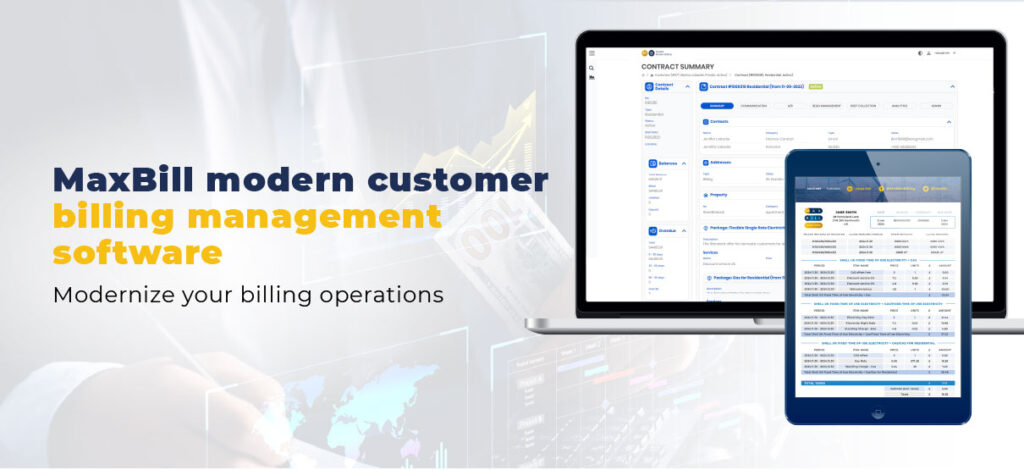
MaxBill is a modern customer billing management software for energy and utility suppliers, which includes CRM, billing, complex partner agreement management, invoicing and reconciliation. In this piece, we answer the top 17 most-asked questions from project owners seeking modern billing systems for their energy and utility businesses.
Traditionally, they come up with the intention of finding a comprehensive billing solution to replace the organisation’s current legacy system. In many cases, it lacks the flexibility and automation needed to support dynamic tariffs, smart metering, and real-time billing, and, most importantly, scalability.
For your utmost convenience, we divided the questions into key domains and Parts. This is Part 1, where you find the answers to the most frequently asked questions around billing, CRM, and Product Catalog. But before, let us first address the points related to the company’s background.
Without further ado, let’s get started.
Company background
What kind of business models does modern customer billing management software for the utility industry support?
Traditionally, modern billing systems support energy and utility service providers with B2B, B2C, and B2G business models.
Which currencies can a modern customer billing system for energy and utility use for pricing, invoicing, payments and partner reconciliation?
Modern customer billing systems for energy and utility can use any currency or multiple currencies for pricing, invoicing, payments and revenue reconciliation. The user needs to define the basic currency and provide the currency exchange rate of multiple currencies against the basic one.
For example, your company is based in Poland, and the basic currency is the Zloty for the whole system. But you do business in the Baltics or Balkans. Utility customers pay in the currency of their location, but the system converts it into the basic one required by the mother company.
What languages can modern customer billing management software for energy and utilities support in UI systems and documentation?
Billing systems for utility service providers support multi-language UI by leveraging a built-in translation tool. Additionally, it is not limited to the type of alphabet or writing (e.g., Latin alphabet or Arabic writing). Translations are automatically spread across the system, including documentation generation.
Infrastructure
How many people are designed to concurrently use modern customer billing management software?
The vendors of modern billing systems do not limit the user count for their solutions. There are no limits by departments, frequency of use (8 hours per day, several times per day, daily, weekly, occasionally). However, the number of users is clearly defined in a license agreement, where the company’s representatives indicate the number of users to have access to the billing system.
Is the modern customer billing system for energy and utilities compatible with different databases?
Modern billing platforms for energy and utility work with relational and non-relational databases. Relational ones store structured data in related tables, while non-relational one doesn’t force data into tables. Instead, it stores things in more flexible ways. At MaxBill, billing teams work with Oracle, PostgreSQL, Cassandra, etc., inside its tools.
Does the customer billing system consider data retention policies in specific countries or companies?
Modern billing solutions for energy and utilities, like MaxBil,l factor in retention policies in a particular country or company. This includes retention time, archival rules, data formats, and the permissible means of storage, access, and encryption.
Customer billing systems like MaxBill are built with GDPR compliance at its core, ensuring secure data handling, configurable retention policies, and full audit trails for every billing and customer activity. This gives utilities complete transparency, regulatory readiness, and peace of mind.
Sales and marketing
How is contract initiation done in modern customer billing management software for energy and utilities?
In modern customer billing management systems, contract initiation depends on how simple or complex the activation process is. For straightforward business models (for example, EV charging or digital services), customer data is received from third-party sources such as mobile apps or supplier websites, and the contract, along with initial financial settlements, is activated automatically via API.
For more complex scenarios, like gas or electricity connections that require on-site visits, meter installation, or technical checks, contract initiation becomes a process rather than a one-click action.
In these cases, data arrives either from external systems (for example, meter data platforms) or from the supplier’s website as a connection request. The billing system triggers a workflow-driven activation process, where steps are completed sequentially until all required information is available.
Once the workflow is finished, the customer contract becomes active. Activation can be started either by third-party systems or by a CSR, who can progressively add missing data as it comes in. This allows contracts to move forward even when not all details are available upfront.
Supported material:
Does modern customer billing management software for utility and energy industry support multiple brands and white labels?
Nowadays, advanced billing systems for the energy and utility industry support multiple brands and white-label operations within a single billing platform.
For example, at MaxBill, the company Integrio runs three separate brands on one MaxBill system, issuing invoices for all brands from the same instance while keeping brand-specific self-care portals, logos, and invoice formats for each. This is enabled through MaxBill’s multi-tenancy architecture, allowing companies to manage multiple brands centrally while preserving independent branding and customer experiences.
CRM
When implementing modern customer billing management system for energy and utility, customer data migration is required. Is this bespoke or standardised?
Customer data migration in modern energy and utility billing projects is primarily standardised. MaxBill provides dedicated migration tools that expect data in predefined formats tailored specifically for the utilities industry, and customers are asked to prepare their data accordingly. For example, in smaller projects, migration is completed using these standard tools and data formats.
However, when customer data comes from different sources, uses non-standard formats, or includes country-specific fields (such as address structures that vary between countries), the standard migration framework is lightly customised.
In practice, this means MaxBill relies on proven, industry-ready migration templates for most data, and adapts them only where local or customer-specific requirements apply, keeping migration structured, predictable, and efficient rather than fully bespoke.
Supported material:
Removing the fear of utility CIOs about implementing modern SaaS billing and CIS solution
How does data migration work within an customer billing management solution? (tools, responsibilities, effort)?
Data migration within an energy billing solution is a joint, structured effort between the customer and the billing vendor. On the customer side, a dedicated person is responsible for data ownership, preparation, and validation, while on the vendor side a migration specialist leads the migration process and tooling.
Both sides align data formats and structures upfront, coordinate with developers if transformations are needed, and ensure business processes are properly understood and reflected in the data. Such shared responsibility model keeps migration controlled, transparent, and efficient. This reduces risk while ensuring the new billing system starts with clean, reliable data.
What are the cost implications when migrating data to a new customer billing management software?
The cost of data migration largely depends on how well the customer’s data fits MaxBill’s standard migration formats. If the data aligns with these formats, migration is typically covered within the agreed project scope and defined directly in the contract.
However, if the customer requires format extensions, structural changes, or country-specific modifications, these efforts must be assessed upfront and included in the contract based on the number of specialists involved.
Costs also scale with the size of the customer base. Migrating 20,000 customers is naturally very different from migrating 100,000 or more, making project scope and data complexity key cost drivers.
Product Catalog
What is Product Catalog in the customer billing management software for energy and utilities?
The product catalog within modern billing software for utilities and energy suppliers is a single environment for maintaining the company’s technical and marketing proposals about all product offers.
The system allows for the definition of offerings that will combine products from different or the same vertical market or customer range.
The product catalog efficiently integrates product information with pricing strategies and synchronizes the product catalog across all operation support systems (OSS) and billing support systems (BSS).
This is where commercial teams can check complex product hierarchy and packages, cross-product mapping concept, manage product lifecycle, modify parameters for products, etc.
With MaxBill AI billing, product configuration is done in clicks, product offers – in minutes thanks to trained AI assistants.
What kinds of product lines and energy services does a modern customer billing management software support?
A modern billing solution supports a wide range of product lines and energy services, covering both traditional utilities and newer business models. This includes electricity billing with daily or monthly standing charges, connection and disconnection fees, as well as advanced scenarios for C&I customers with hourly or half-hourly consumption tracking.
Beyond electricity, modern platforms handle gas, water, heating-as-a-service (including heating and cooling combinations), hot and cold water, sewerage, and EV charging with partner commission models.
They also support renewable offerings, such as solar rooftop installations, where customers may receive installation credits, tariff discounts, and usage-based billing. All this is managed within a single billing system.
Supported material:
More choice and enhanced value for your customers with MaxBill Product Catalogue
What rules of package configuration for different product lines does modern customer billing management software support?
Modern billing systems for energy and utility suppliers support flexible package configuration rules that allow energy and utility providers to combine multiple product lines, services, and price plans into a single customer offer.
At the core is the Service Package. This is the main contract between the customer and the provider. A service package can include multiple product items, price plans, and discounts, each instantiated as a service and governed by predefined relationship rules. These rules control what must be included, what is optional, and how customers can choose between alternatives when a package is assigned.
At MaxBill, typical configuration rules include:
- Mandatory services – components that are always added to the customer contract (for example, a monthly standing charge or core electricity service).
- Optional services – add-ons the customer may choose, such as discounts or installation support.
- One-of groups – the customer must select exactly one option from a defined group (for example, choosing one tariff from several alternatives).
- One optional – the customer may select zero or one service from a group.
- One or more – the customer can select multiple services from a group.
What kinds of pricing models can a modern customer billing system support?
Modern billing systems support a wide range of pricing models to reflect how energy and utility services are actually consumed and sold. The classic billing is a postpaid one, where customers are charged after actual usage is measured.
Other pricing models include time-based pricing, such as half-hourly (HH) and hourly billing, fixed prices per day or year (annual subscriptions), recurring subscriptions, usage-based tariffs, and discounts. There are even alternative units like price per square meter (m²) for heating or property-based services.
They also support prepaid models, where businesses pay in advance based on estimated consumption (using advance invoices or credit balances).
Supported material:
How innovative utility pricing solution helps stand out in the fierce competition?
How does the modern customer billing management software for energy and utility support revenue sharing or partner agreement commissions?
Modern energy and utility billing systems support revenue sharing and partner commissions through configurable relationship rules and financial agreements between participating parties. For example, in the EV charging business, partners, such as EV charging station owners or service providers, are defined as participants in these agreements, with commissions calculated either as a fixed amount or as a percentage of the revenue generated by a specific asset (for example, a charging station).
The billing system applies these rules automatically based on the configured relationships, ensuring that partner payouts follow the financial terms of each contract. This removes manual calculations and enables transparent, scalable settlement across partner ecosystems.
Supported material:
How automated processes in revenue management help utility revenue managers boost cash flow
Does a modern customer billing management system support the discounts that energy and utility suppliers offer?
Yes, modern customer billing systems fully support supplier discounts through configurable discount plans that are built directly into the service package.
A discount plan becomes part of the customer’s package and follows predefined business rules. For example, applying a discount to all services in the package or only to specific ones, depending on the supplier’s market offer (such as bundled electricity + gas + EV charging).
During billing, the system automatically applies the discount based on what actually appears on the invoice: if the discount is defined for electricity but electricity isn’t present in that billing cycle, no discount is applied; if the discount covers all services, it is applied across the entire invoice.
Finance
What payment methods are supported by a modern customer billing management software for energy and utilities?
Modern billing systems for energy and utilities support a wide range of payment methods to meet both customer preferences and regional requirements. These typically include credit and debit cards, direct debit, bank transfers, and vouchers (commonly used in the UK). Cash is technically supported but rarely used in practice.
Does a modern customer billing system support any kind of prepaid payments for electricity usage?
Yes, modern billing systems fully support prepaid electricity models for both business and residential customers.
In the C&I segment, prepaid payments are commonly used for large consumers, where suppliers need estimated future consumption to procure and reserve electricity or gas volumes from the grid in advance.
In these cases, suppliers issue advance invoices to business customers, ensuring funds are received before capacity and energy volumes are purchased.
On the residential side, prepaid models are also supported through prepaid meters. If the prepaid balance runs out, supply is automatically stopped until the customer tops up. This allows suppliers to manage risk while guaranteeing payment ahead of consumption.
Does a modern customer billing management software for energy and utility perform any type of credit limit checks?
Yes, modern energy and utility billing systems support credit limit checks by integrating third-party credit scoring services via APIs. When a new customer is onboarded, the billing platform can request a credit assessment (for example, returning results like good, suspicious, or excellent) to understand the customer’s financial reliability. This includes whether they have prior issues such as collections or court cases.
Based on this credit information, the billing system helps determine the appropriate payment model during contract initiation: whether the customer can be offered credit-based tariffs, should be placed on prepaid meters, or must use direct debit for automatic payments.
Do customer billing management systems for energy and utility include debt collection?
Yes, modern energy and utility billing systems don’t just issue invoices and accept payments; they also track outstanding balances and monitor customer debt. This way, suppliers identify overdue accounts early and manage receivables as part of the end-to-end billing process.
Billing
Does MaxBill customer billing management software for energy and utilities analyze discrepancies in billing and show where to capture those refunds?
Yes, customer billing systems support discrepancy analysis by comparing expected revenue with actual payments at the close of each financial period. Once all invoices are issued and payments are received, the system helps suppliers review monthly results. For example, identifying gaps between forecasted revenue (such as expected consumption or procurement volumes) and what was actually collected.
If there’s a shortfall, billing system enables an analytical review to determine whether the difference comes from inaccurate consumption forecasts or from billing calculation issues. This monthly “expectation vs reality” control allows suppliers to detect anomalies, investigate root causes, and identify where refunds, corrections, or billing adjustments may be needed.
Does MaxBill customer billing management solution contain low-code automation tools for handling billing exceptions and re-invoicing?
MaxBill supports low-code automation for managing billing exceptions and re-invoicing through built-in billing workflows. During the billing process, invoices go through verification stages. If validation fails, the invoice is not issued and errors can be corrected before regeneration.
If an invoice has already been released and an issue is discovered (for example, pricing was calculated using outdated rates), users can annul the invoice with a single action, update the pricing, and relaunch invoice generation. This enables fast correction cycles without manual recalculation. This way, teams resolve billing exceptions efficiently.
How many invoices or bills per month can the modern customer billing management software for energy and utilities generate?
Modern billing systems like MaxBill place no practical limits on invoice volume. Invoicing frequency is fully configurable. Suppliers can generate weekly bills, monthly bills, or ad-hoc invoices on demand (for example, when a customer requests a current balance).
Both scheduled and on-demand billing are supported. Utilities can scale from small customer bases to high-volume operations without restrictions.
What energy models or plans does a modern customer billing solution for energy and utilities support?
Modern billing systems for energy and utilities support a wide range of energy models and pricing plans to reflect how customers consume power today.
These include the following:
- subscription-based models with flat monthly fees for predictable costs
- usage-based pricing such as hourly and half-hourly tariffs,
- time-zone or time-of-day pricing (for example, different rates during daytime vs midnight)
- tiered pricing where the unit price changes after defined consumption thresholds.
Customer billing management software also supports bundled and hybrid models, such as preferential pricing when customers combine grid electricity with solar energy consumption or EV charging. In addition, modern platforms handle mixed subscription + consumption models, enabling suppliers to launch flexible, market-driven offers while maintaining accurate billing and forecasting.
Supported material:
SaaS subscription billing solutions for energy and utility to thrive in 2026
Automated billing solutions for small utilities to cut costs and get needed agility
Energy as a service provisioning model: power of digitalisation
How long does the current bill cycle take in MaxBill?
There is no fixed billing cycle duration in MaxBill. It depends on operational factors rather than hard system limits. Once validated consumption data is available and ready for billing, the cycle can be initiated whenever the supplier needs.
The overall billing timeline varies based on the number of customers, customer segmentation, billing frequency (monthly, quarterly, etc.), and how quickly consumption data arrives from third-party systems.
A key factor here is data validation. MaxBill first checks incoming consumption data for format, consistency, and completeness before billing can start, ensuring billing accuracy before invoices are generated.
How many variations of VAT does the modern customer billing management software support?
A modern billing system handles country-specific VAT rules separately for B2C and B2B, including reduced rates, exemptions, and tax-free services. It also applies additional configurable taxes such as excise duties (for example on fuel) and market-specific levies like the Climate Change Levy for large business consumers in the United Kingdom.
In practice, VAT becomes a multi-dimensional framework covering customer type, product category, and local regulation. This is all configured in modern invoicing systems like MaxBill.
Supported material:
How MaxBill helps energy suppliers achieve ViDA e-invoicing compliance
Does MaxBill customer billing service for energy and utilities provide invoice templates?
In practice, every supplier has its own branding (logos, colours, fonts) and must also comply with government-mandated invoice content. Often, including consumption trends (for example, comparing this year vs last year). Companies provide their branding and layout requirements, and such customer billing management software as MaxBill configures these directly in the billing system, so invoices are generated automatically in the exact required format. They are fully branded and regulation-compliant.
Does MaxBill provide complex subsidy management?
Yes, MaxBill supports complex subsidy management by treating subsidies as configurable discounts and invoice adjustments tied to specific programs or customer groups.
In practice, this covers different scenarios. This could be government vouchers that customers use to pay for electricity, state-funded gas discounts where money is passed from the government to suppliers and then applied to customer bills.
There are also charity-backed subsidies for vulnerable consumers. MaxBill allows suppliers to configure these discounts directly in the billing system, add explanatory text on invoices (for example, noting that a reduction comes from a government program), and automatically apply the subsidy to the final price.
Can MaxBill support different billing schedules and estimations?
Yes, MaxBill supports flexible billing schedules and automated estimations. Suppliers can run billing on fixed cycles or on demand. If real meter readings aren’t available by the end of a billing period, the system can generate bills based on estimated consumption. When actual readings arrive later, MaxBill can reconcile the difference.