




























Can MaxBill energy utility billing software be integrated with our ERP? Can it deliver energy consumption to our branded app? These are questions that we get from modern energy and utilities service providers. And in this Part III, our product owners and project managers are answering the questions about integrations, user access to a billing system, portal for customer care and UX.
Let’s get closer to the answers.
Integrations
Which companies offer smart energy utility billing software with app integration?
Modern energy and utility billing solutions do support app integration so that customer data, consumption, invoices, and payment status can be displayed and interacted with on mobile devices. MaxBill is one such platform. It can integrate with a customer-facing app or web portal, feeding the mobile app with billing data, usage history, and account details in real time.
What integrations are supported by the advanced billing system for energy and utilities?
Billing solutions for the energy and utility suppliers allows for the integration of the market messaging systems (automated SMS), procurement software, if necessary, integrations for receiving payment transactions, bank reconciliation, BACS payments, CAIS, regulatory and market settlement systems; metering databases for consumption data import; integrations for switching, new registrations, terminations; BI reporting.
Does MaxBill energy utility billing service integrate with DNO messaging and central data hubs?
The DNO messaging is a market messaging system. MaxBill fully integrates with any market messaging system and any local central data hub (e.g., Energie Data Services in Nederland, automated exchange of energy metering, allocation, and switching data between Dutch grid operators, suppliers, and market parties) to help energy and utility companies run their activities.
Does MaxBill have the ability to integrate with existing systems (CRM, ERP, trading, payments)?
Yes, via API, MaxBill can integrate with any existing system within the ecosystem of service suppliers.
Can parts of the energy utility billing software be replaced with utilities’ own systems via API?
Yes, modern billing platforms like MaxBill are designed to be API-first. This means individual parts of the system can be replaced or complemented by a customer’s own tools. Suppliers don’t have to replace their entire IT stack. For example,
- Tariffs can live in an external portal or third-party system. MaxBill simply pulls them via API and applies them during billing.
- Consumption data can come from external metering or market systems, which MaxBill then combines with the correct tariffs to calculate charges.
- CRM is often owned by the customer. In that case, MaxBill connects via API to retrieve customer and contract configurations instead of duplicating that logic.
Does MaxBill perform data extraction and reporting (Power BI, Data Lake)?
Yes, MaxBill supports data extraction and external reporting workflows, but it doesn’t try to replace your analytics stack.
In practice, MaxBill provides structured data exports (via files or APIs) that customers feed into their own analytics environments. For example, Microsoft Power BI for dashboards and reports, or a Data Lake for large-scale storage and advanced analytics. MaxBill’s role is to prepare clean, consistent billing and operational data; customers then use Power BI or their Data Lake to build interactive reports, AI insights, and custom visualizations on top of it.
What deployment options does MaxBill deliver (SaaS, private cloud, on-prem)?
MaxBill energy utility billing software offers flexible deployment options so utilities can choose what best fits their IT strategy and regulatory constraints:
- SaaS (cloud-hosted by MaxBill): fastest to launch, fully managed by MaxBill, with updates, security, and infrastructure handled for you.
- Private cloud: deployed in your own cloud environment (or a dedicated cloud tenant), giving you more control over data residency and integrations, while keeping cloud scalability.
- On-premise: installed in your own data center, typically chosen by highly regulated utilities or organizations with strict internal IT policies.
User roles, permissions and audit
Does the energy utility billing software provide an audit trail?
Yes, MaxBill provides a fully configurable audit trail. What gets tracked is set per project (for example: customer changes, contracts, services, charging points, prices, including create/update/delete events).
Once enabled by the customer’s admin IT team, MaxBill logs who made each change, what was changed, the old and new values, and the exact date/time, and presents this either on screen or in tabular reports, depending on audit volume. MaxBill also trains the customer’s team so they can manage these audit settings independently.
Can senior managers of E&U suppliers assign specific user permissions (e.g., only authorised personnel can change tariffs)?
Yes, MaxBill energy utility billing software supports role-based user permissions. Senior managers can define exactly who can view, create, modify, or delete critical items like tariffs, contracts, or services. Only authorised personnel can make pricing changes, while others may have read-only access.
Portal & UX
Can the self-service portal of energy utility billing software be branded per supplier label?
Yes, in MaxBill, the self-service portal is fully brandable per supplier or label. Each provider can apply their own logo, colors, fonts, and layout. Customers always see a portal that matches the supplier’s brand identity, even in multi-brand or white-label setups.
Can one user see multiple companies or connections?
Yes, MaxBill supports multi-company visibility with role-based access. There’s always a default (master) company whose users, typically administrators or managers, can see and manage multiple companies or connections. Users belonging to individual companies, however, only see their own data.
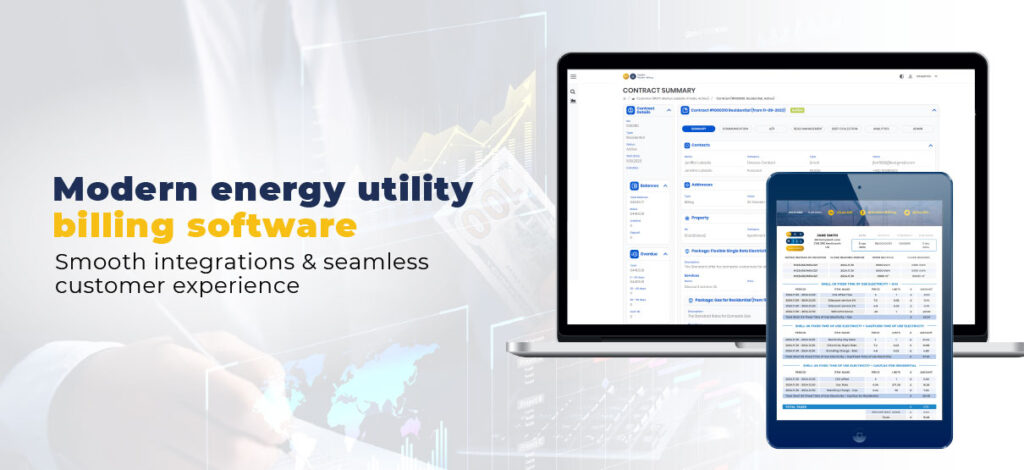
Does MaxBill energy utility billing software integrate with a mobile app or provide it?
Yes, MaxBill integrates with mobile apps, but it typically doesn’t provide its own end-user app. In practice, utility companies use their own customer apps, and MaxBill connects to them via APIs. It securely passes billing data such as consumption, invoices, balances, and account details so everything is visible on the customer’s mobile device.
Supported material:
Beyond the Bill: Rethinking Customer Experience in Utilities in 2026